Introduction
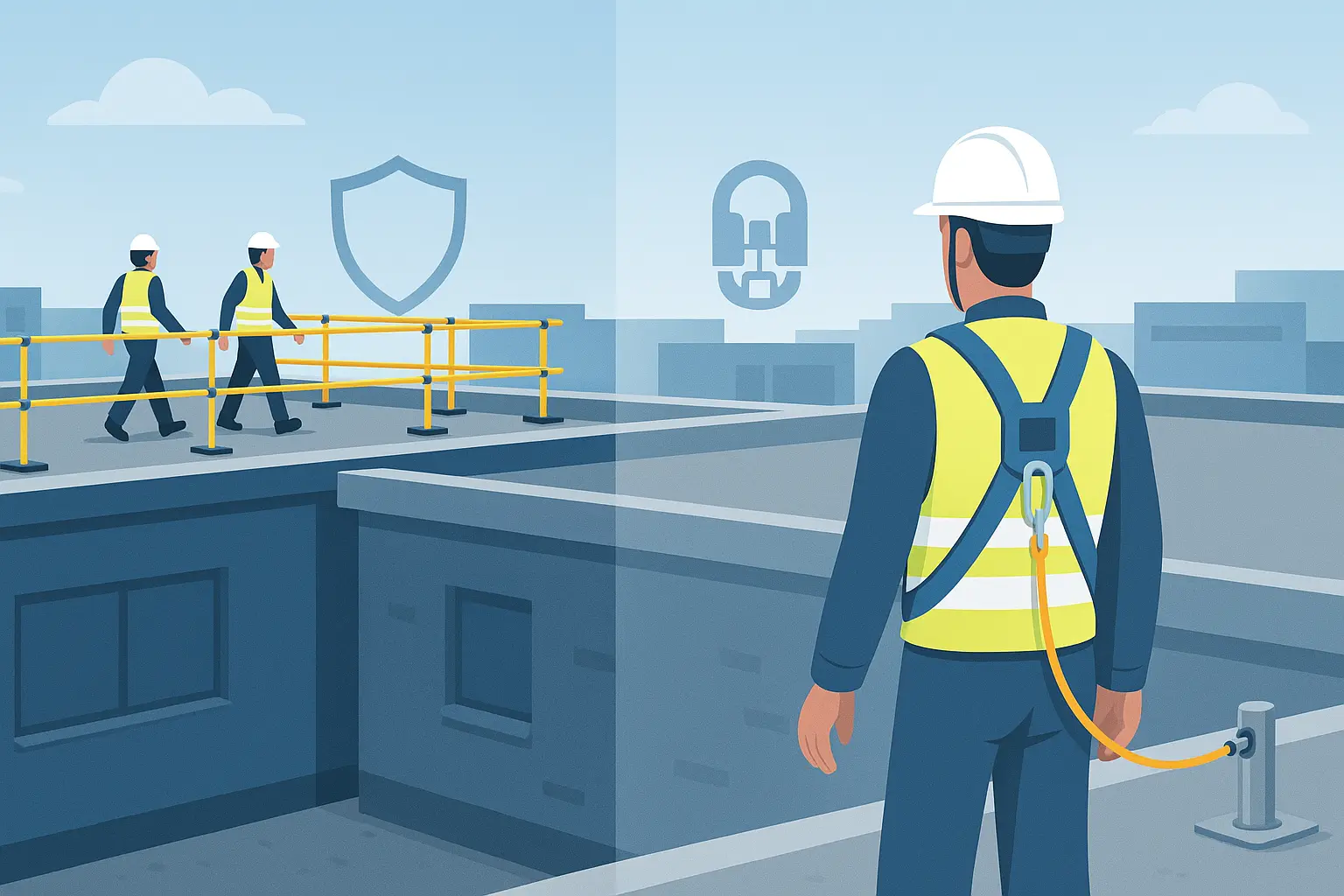
Working at height remains one of the most hazardous activities across various industries. In fact, falls from height are consistently among the leading causes of workplace fatalities. For health and safety managers and professionals, this stark reality underlines the importance of robust fall protection measures. Two common solutions to protect workers on rooftops and other elevated areas are guardrail systems and horizontal lifeline systems. How do we decide between guardrails or lifelines? The answer lies in understanding the Work at Height Hierarchy of Control. This guide will walk through the work-at-height safety hierarchy and compare guardrails versus lifelines in real-world scenarios.
Understanding the Work at Height Hierarchy
The Work at Height Regulations 2005 (in the UK) outline a clear hierarchy of control measures for managing fall risks. In simple terms, this hierarchy prioritizes eliminating and preventing fall hazards over merely mitigating them. Here’s a brief overview of the hierarchy in practice:
- Eliminate the Hazard: First and foremost, avoid working at height if you can. Plan the work so that tasks can be done from the ground or a safe location whenever possible.
- Collective Fall Prevention (Passive Protection): If working at height is unavoidable, implement measures that prevent falls for everyone exposed – without needing action from individuals. This typically means installing collective protection like guardrails, edge protection, or safety barriers around the hazard. These solutions physically block a fall from happening.
- Personal Fall Prevention / Restraint: If collective measures are not feasible, the next preference is to use personal protective equipment in a way that prevents a fall. For example, a horizontal lifeline can be configured as a fall restraint system, keeping the worker’s harness tether short enough that they cannot reach the roof edge. This still requires correct use by each worker but aims to avoid a fall entirely.
- Personal Fall Arrest (Active Protection): When neither collective prevention nor restraint can fully eliminate the risk, personal fall arrest systems (like horizontal lifelines or anchor points with lanyards) are used. These will not prevent a fall, but if a fall occurs, the system arrests it to stop the person hitting the ground. For instance, a lifeline system used with a shock-absorbing lanyard will catch a falling worker. Because a fall arrest entails someone actually falling, it’s considered a lower priority than prevention or restraint – and it comes with the critical requirement of a rescue plan to quickly recover the suspended worker.
- Administrative Controls & Training: Alongside the above measures, ensure workers are trained, procedures are in place, and hazards (like fragile roofs or weather conditions) are managed. Administrative controls (signage, work permits, etc.) and proper training are essential supports to the physical safety measures, but they are the last line of defense. They rely on people following rules, so never use them as a substitute for proper fall protection equipment.
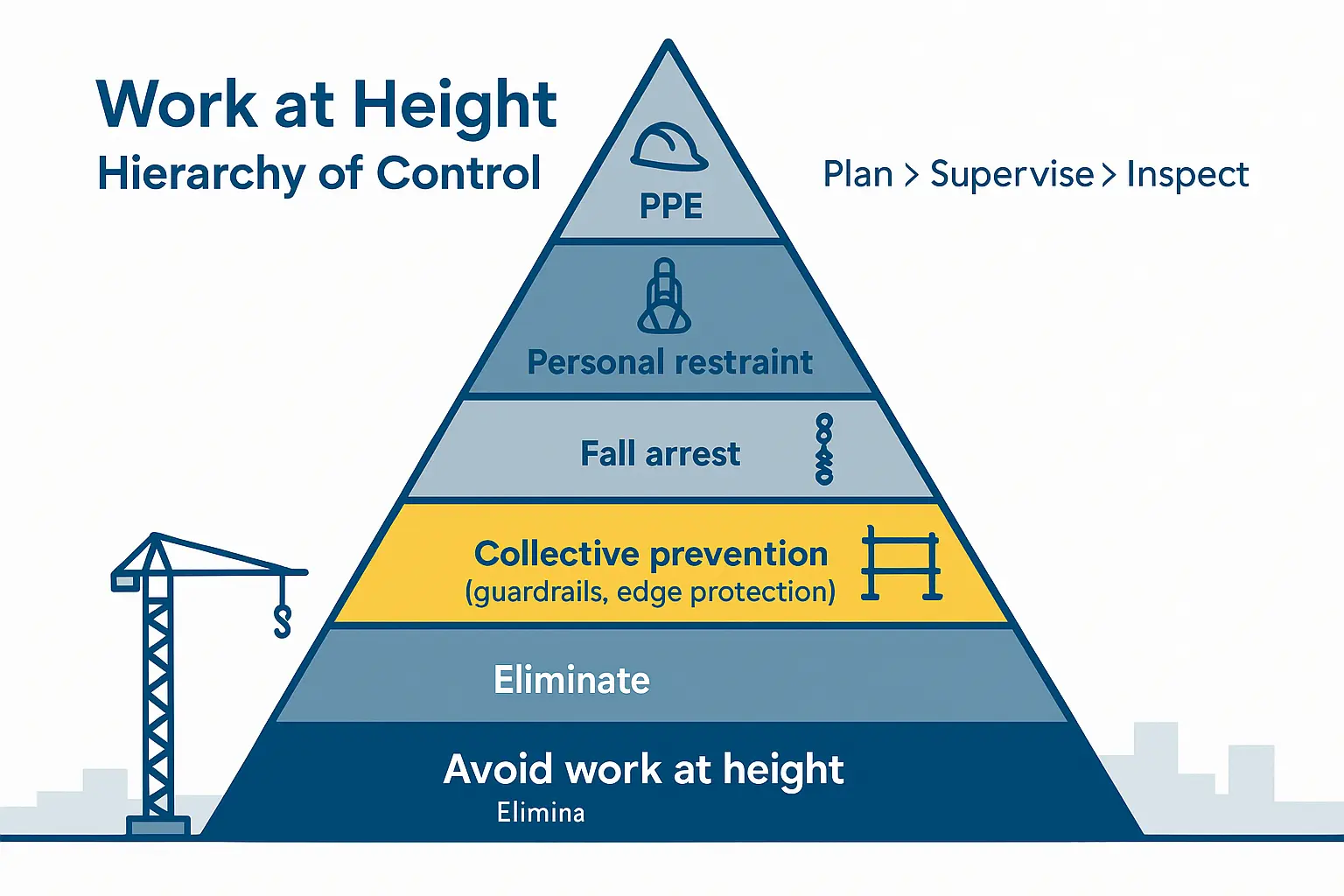 The key takeaway from the hierarchy is that you should select the highest level of protection practicable for your situation. A well-known principle from the regulations is: “Avoid working at height if you can. If not, prioritise collective protection (like guardrails) over personal protective equipment (like a safety harness)”. In other words, whenever possible, use a solution like guardrails that protects everyone automatically, before considering systems that require each worker to take action (like hooking their harness to a lifeline). With that foundation, let’s look more closely at each solution.
Guardrails – Collective Protection that Prevents Falls
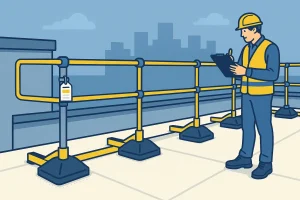
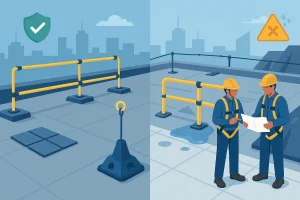
Guardrails are a form of passive, collective fall protection. They are physical barriers (rails or parapets) installed along roof edges, mezzanine perimeters, platform edges, or other fall-risk areas to stop people from falling over. Guardrails sit near the top of the safety hierarchy because they provide continuous protection without any active participation from workers. Once a compliant guardrail is in place, anyone in that area is protected simply by the barrier – they don’t need to wear special gear or remember to hook into anything. As the HSE defines it, guardrails are effective “collective protection” because they don’t require individuals to act for the system to work.
Advantages of guardrail systems:
- Prevents falls entirely: A guardrail’s primary benefit is that it stops a fall before it starts. Unlike a harness or lifeline that intervenes after a fall has begun, guardrails keep workers from stepping off the edge in the first place. This proactive protection is the safest approach whenever feasible.
- Easy to use – minimal training: Using a guardrail doesn’t require special action or equipment from workers. There’s no need to clip into a harness system or wear extra PPE (aside from standard precautions like perhaps a helmet). Essentially, “don’t climb over the rail” is all one needs to know. This simplicity means guardrails are highly reliable; there’s little room for user error compared to active systems.
- Continuous, collective protection: Guardrails protect all personnel in an area simultaneously. Whether one person is on the roof or ten are, the guardrail doesn’t get overwhelmed or require additional gear. This is ideal for places with frequent access or multiple trades working at once (e.g. during construction or maintenance activities).
- Low ongoing maintenance: Quality guardrail installations (permanent or modular systems) are usually made of durable materials (galvanized steel, aluminum, etc.) and require only periodic inspections. There are no mechanical or moving parts in a basic fixed guardrail, so once installed, maintenance is minimal. Regular visual checks and perhaps an annual inspection to ensure no sections have been damaged or loosened is typically sufficient.
- Cost-effectiveness for long term: While the upfront cost of a large guardrail installation can be significant, it often pays off over time. There are no additional personal equipment costs (like harnesses or lanyards for every user) and no elaborate training programs needed for basic use. For rooftops that see constant traffic (like data centers with monthly equipment checks or industrial plants with routine roof access), a permanent guardrail system can be more economical and convenient than managing lifeline gear for each visit.
Limitations or considerations with guardrails:
- Feasibility and roof structure: Not every roof or structure can support guardrails in all areas. You need a suitable base or parapet to attach or clamp the guardrail, or you might use free-standing weighted base rails on a flat roof. If the roof is very irregular, has rounded edges, or space constraints, installing a continuous perimeter rail might be challenging. Structural engineers should ensure the roof edge or substrate can handle the load if the guardrail is fixed (especially for permanent rails that must withstand forces per standards like BS EN 14122-3).
- Space and accessibility: Guardrails take up some space along edges and around equipment. For example, if a rooftop area is very narrow or has many obstacles at the edge, a guardrail might not be practical without impeding other uses. Workers are essentially restricted to inside the guarded zone – if something needs doing outside that zone, additional measures would be required (temporary removal, use of PPE, etc.). In complex layouts (think rooftops crowded with pipework, skylights, or plant equipment), you may not be able to box out every hazard with rails without it becoming an obstacle itself.
- Aesthetics and planning constraints: Especially on commercial or public buildings, the appearance of guardrails can be a concern. Some building owners or architects resist permanent guardrails due to how they alter the building’s look (visible from the ground, etc.). There are solutions like folding guardrails that lie flat when not in use, but if aesthetics or planning permission issues arise (in certain city centers or historic buildings, for instance), lifelines or other less visible measures might be preferred.
- Not flexible once installed: Guardrails protect a defined area. If future work needs extend beyond those areas (say new equipment is added near an unprotected edge), the guardrail layout might need to be modified or expanded. They are not as easily reconfigured for different tasks compared to a lifeline where a user can walk along a cable to various points.
In summary, guardrails are the go-to solution for fall prevention at height because they actively prevent falls without relying on individual behavior. Whenever a rooftop or platform is accessed regularly and the installation is practical, a guardrail system is usually the safest and simplest choice. This aligns perfectly with the hierarchy principle of collective protection first. Next, we’ll look at the alternative: lifeline systems, which come into play when guardrails aren’t an option or as a supplementary safety measure.
GuardAngel Guardrail
For specifications, testing and installation guidance on the GuardAngel roof-edge guardrail from Universal Safety Systems, click the link.
Horizontal Lifelines – Personal Fall Protection Systems
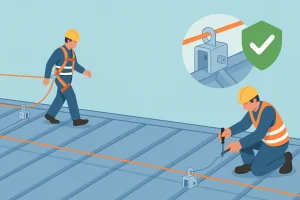
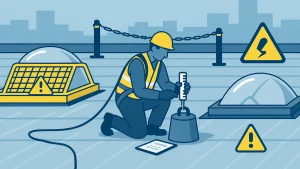
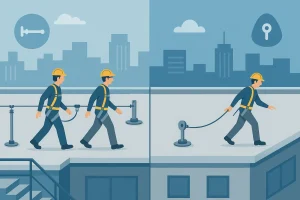
Horizontal lifeline systems (HLLs) are engineered cable or rail systems that run along a work area, allowing a person wearing a harness to tie off and move safely. Unlike guardrails, which passively block a fall, lifelines are an active form of fall protection – they require the worker to use them correctly. Each worker wears a full-body harness connected by a lanyard or shuttle to the lifeline cable. As the worker moves, the tether travels along the cable (often through intermediate anchor points) giving them mobility across the roof or structure. If they slip or reach an unprotected edge, the lifeline will arrest their fall (typically via an inline shock absorber that absorbs the force). In some configurations, lifelines can also be used in restraint mode to prevent the worker from getting to the edge at all, effectively acting as a leash that stops short of danger. Horizontal lifelines are commonly used on rooftops where installing perimeter guardrails is impractical or undesirable. They’re also found on long spans like loading bay roofs, alongside skylights or fragile surfaces (to protect workers while they traverse those areas), and on large industrial equipment or cranes for maintenance access. USS provides lifeline systems that are tailor-made for each site – for instance, a stainless steel cable lifeline with energy-absorbing anchor posts spaced along a warehouse roof, or a rigid rail lifeline over an assembly line. These systems are designed to meet strict standards (such as EN 795 for anchor devices and lifelines) and must be installed by competent professionals. When properly set up, a lifeline offers a safe anchorage wherever the worker goes along its path.
Advantages of lifeline systems:
- Flexibility and reach: Lifelines shine in scenarios where workers need to access wide or complex areas at height. For example, imagine a sprawling data center roof dotted with HVAC units and vents. A lifeline system can be installed in a way that a worker can clip on once and walk the entire roof—navigating around obstacles—while remaining secured. This is far more flexible than trying to install guardrails around every piece of equipment or along every twist and turn of the roof. Lifelines offer freedom of movement, which is crucial for tasks like inspecting multiple points on a roof or doing lengthy gutter and solar panel maintenance runs.
- Adaptable to various structures: Horizontal lifelines can be engineered for many different roof types (metal seam roofs, concrete rooftops, pitched roofs) and even for indoor elevated work zones. They can be fixed to roof stanchions, wall brackets, overhead beams, or other support structures. If your project involves an unusual building geometry or a sensitive roof where penetrating the membrane for guardrail posts is a concern, a lifeline might be a viable alternative. Many lifeline systems use discrete anchor points and low-profile cables that won’t interfere with roof integrity or drainage when properly installed.
- Lower profile (aesthetics): In cases where visible guardrails are not acceptable, lifelines are a much less conspicuous solution. From ground level, you might not even notice the small anchor posts or cables. This is a big reason architects sometimes opt for lifeline systems on modern buildings or historical sites – they preserve the visual sightlines of the structure while still providing fall protection for those who need to go on the roof.
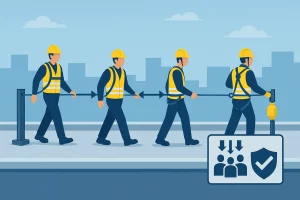
- Can serve multiple users: Lifelines are typically rated for a certain number of simultaneous users (e.g., a 2-user or 4-user system depending on design). This means a team of workers can all attach to the same line (with appropriate spacing) and work together along a roof or gantry, which is important for efficiency during larger jobs like solar panel installations or roof repair projects.
- Restraint capability: As noted, a well-designed lifeline can act in fall restraint mode – effectively preventing users from reaching a fall hazard. This is ideal because if no one can fall off an edge due to the lanyard length, you’ve achieved the same outcome as a guardrail (fall prevented) but with a different method. In practice, restraint systems require careful calculation of lifeline length, anchor placement, and lanyard length to cover the needed work area while still stopping short of any edge.
Challenges and requirements of lifelines:
- Dependence on user behaviour and training: Perhaps the most significant drawback of lifeline systems is the human factor. The lifeline only protects those who correctly hook their harness lanyard to it – and it only works if they stay attached. A worker who forgets to clip on, or who unclipped “just to quickly grab a tool” is essentially unprotected. Moreover, using a lifeline safely isn’t as simple as using a guardrail; it requires proper training and a solid safety culture. Workers must know how to wear their harness properly, how to adjust lanyards, how to move along the line without creating slack, and how to respond if someone falls. Not every organization has the time or resources to ensure every operative is that well-versed. As one industry writer noted, lifelines “lend themselves to human failure” because they rely on perfect usage every time. In contrast, a guardrail doesn’t require anyone to remember anything – it’s just there. So, H&S managers need to weigh this carefully. If your team has high turnover or limited training, a complex lifeline system could be a liability unless accompanied by thorough training programs.
- Must have a rescue plan: If a fall does occur and a worker is hanging in their harness, this is an emergency. Suspension trauma can set in within minutes. Therefore, any use of personal fall arrest systems like lifelines necessitates a detailed rescue procedure. This might involve having a trained rescue team on site or specialized equipment (like rescue ladders, winches, or inertia reels) readily available. In a small maintenance team, this can be hard to arrange. By contrast, if guardrails are used, the hope is that nobody falls at all, and thus rescue becomes a non-issue. Planning for rescue is a critical part of lifeline system implementation – and something regulators will expect in your risk assessments.
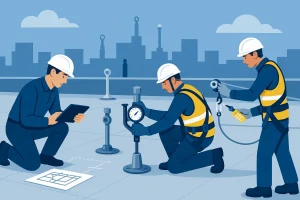
- Inspection and maintenance burden: Lifeline systems, being safety-critical, require regular inspection and recertification. In the UK, for example, most horizontal lifelines need a competent person to inspect and recertify at least once a year (per BS 7883 / BS EN 365 guidelines) to ensure the tension is correct, components aren’t corroded, and the system would hold up in a fall. Additionally, the personal gear (each worker’s harness, lanyard, connectors) must be inspected before each use and formally inspected periodically. This is a manageable task, but it is another ongoing responsibility for the company. By comparison, a guardrail system also needs periodic checks, but far less intensive – there’s no personal kit to manage and fewer technical components to potentially fail. Health & Safety officers must keep this in mind: adopting lifelines means adopting an inspection regime for both the system and the PPE.
- Initial installation complexity: Installing a horizontal lifeline is a more complex job than installing many guardrails. It often requires specialized engineering input – for instance, calculating anchor loads, ensuring the supporting structure can take the force of an arrested fall, waterproofing any roof penetrations, and properly tensioning the line. The installation might need to be done by certified installers of the specific system. This upfront complexity and cost can be justified when lifelines are truly the best solution for the scenario (e.g., an intricate roof layout where guardrails just won’t work), but it’s something to factor into project planning. Temporary lifelines (like portable rope systems) exist as well for short-term works, but those too require careful setup each time and training in their use.
- Not truly “hands-free” at all times: Some lifeline systems allow a user to move along the entire line without disconnecting (the lanyard trolley passes intermediate points automatically), which is ideal. Others might require the user to detach and re-attach when passing through an anchor point or corner. Whenever a user has to disconnect, even momentarily, there’s a risk (which is mitigated by using a dual lanyard technique, but not all scenarios allow that easily). Guardrails, of course, never have a gap in protection if installed continuously. Modern lifelines try to minimize the need to unhook, but depending on the design, you should consider how easy it is for workers to maintain 100% tie-off.
In summary, horizontal lifelines provide a versatile solution to fall protection when you need mobility and when guardrails aren’t suitable. They are an indispensable tool in many situations – for example, running along the peaks of a large warehouse roof so maintenance crews can reach vent fans, or around the perimeter of a roof where guardrails can’t be fixed due to roof membrane type. However, lifelines shift more responsibility onto the user and the safety manager in terms of correct usage and upkeep. They occupy a lower level on the safety hierarchy because they require active participation and only arrest falls rather than prevent them outright (in fall arrest mode). Therefore, one should choose lifelines after evaluating all higher-level controls, or as a complementary measure to guardrails when full perimeter protection isn’t feasible.
RoofAngel Horizontal Lifelines
For specifications, testing and installation guidance on the RoofAngel Horizontal Lifeline from Universal Safety Systems, click the link.
Guardrails vs. Lifelines: Choosing the Right Solution
Now that we’ve examined both options, how do you decide whether a guardrail system or a lifeline system (or possibly a combination) is the best choice for a given scenario? The decision should be guided by the hierarchy of controls, but in practice it involves considering a range of factors: the nature of the work, frequency of access, roof characteristics, regulatory requirements, and the people involved. Below is a comparison and some guidelines to help make an informed choice:
| Consideration | Guardrails, collective protection | Lifelines, personal protection |
|---|---|---|
| Type of protection | Collective, passive fall prevention that protects anyone in the area without action. | Personal, active restraint or arrest that protects only attached users. |
| Hierarchy level | Higher, prioritised, prevents a fall from happening. | Lower, used where collective measures are not feasible, minimises consequences. |
| Worker training | Minimal, basic awareness not to defeat protection. | High, harness use, connection, and rescue procedures. |
| Ease of use | Always in place, free movement inside protected zones. | Requires donning PPE and remaining attached, movement follows the line path. |
| Mobility and flexibility | Limited to areas within rails, changing areas needs layout changes. | High mobility along the line, reach complex routes subject to safe design. |
| Users at once | Effectively unlimited. | Limited by the system design, for example two users. |
| Inspection and maintenance | Periodic checks of rails and fixings. | System recertification plus daily or pre-use PPE checks. |
| Installation complexity | Often straightforward, modular non-penetrating options exist. | Engineered design, structural verification, correct tensioning. |
| Compliance | Height and strength per Building Regulations and EN 14122-3. | EN 795 and related component standards, EN 361, EN 355, etc. |
| Aesthetic impact | Visible barrier, folding options reduce impact. | Low profile, often barely visible from ground level. |
| Cost factors | Upfront by length and type, low ongoing cost. | Higher upfront, ongoing training and recertification. |
| Typical use cases | Flat roofs with frequent access, mezzanine edges, long-term workplaces. | Large or complex roofs, long spans, or where rails are impractical. |
Guardrails are generally preferred for permanent, regularly accessed areas due to their fail-safe nature, whereas lifelines are a great solution for cases where guardrails won’t work or where access is occasional and more controlled.
Key Takeaways for Safety Professionals
In wrapping up, here are the main points for health & safety managers, project managers, and operatives to take away on the guardrails vs. lifelines question:
- Follow the hierarchy: Always start by asking, “Can we avoid this work at height altogether?” If not, “Can we use a collective measure like a guardrail to prevent falls?” Use personal fall protection (lifelines, harnesses) as a next step when collective options are exhausted or impractical. This approach ensures you’re always opting for the safer solution first in principle.
- Guardrails = peace of mind: If a location is accessed often or by many different people, guardrails offer a robust, low-maintenance safety net. They significantly reduce reliance on individual behavior and PPE. For employers, this means fewer sleepless nights worrying if every contractor will remember their harness tie-off on the roof – the guardrails have you covered.
- Lifelines = flexibility with responsibility: Lifeline systems allow work in areas that can’t be fenced off, but they come with strings attached – literally and figuratively. You accept the responsibility to train users, enforce their use, inspect gear, and plan rescues. When used correctly, they are life-saving systems that enable work in tricky places. But they must be respected and maintained diligently.
- Sometimes both are needed: It’s not always an either/or choice. Many facilities use a blend of guardrails and lifeline anchor points to address different hazards. For example, guardrails around the outer edges, and lifeline anchors by a roof hatch or along a gutter line where someone might need to lean out. Think holistically about all fall hazards on your site – the best protection strategy might use multiple tools in combination.
- Consult experts and regulations: Ensure any system (guardrail or lifeline) is designed to meet relevant safety standards and local regulations. Guardrails should be compliant with height and strength requirements (and if temporary, meet standards like EN 13374 for temporary edge protection). Lifelines should be engineered and certified to standards and installed by qualified professionals. It’s wise to consult fall protection specialists (like our team at USS) who can evaluate your site and recommend solutions. Every roof and situation is a bit different – a solution that works for a solar farm might not suit a heritage building, for instance.
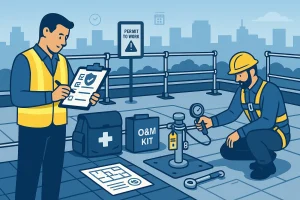
- Don’t forget the paperwork: Whichever solution you employ, document your risk assessments, method statements, training records, and equipment inspections. If an incident were ever to occur, demonstrating that you followed the work-at-height hierarchy and implemented appropriate measures will be critical. More importantly, it ensures that safety management is proactive and systematic, not ad hoc.
Conclusion: Applying the Hierarchy in Practice
Using guardrails vs. lifelines isn’t a rivalry so much as a reflection of the work at height hierarchy in action. Guardrails, as a form of collective prevention, sit towards the top of the hierarchy and are preferable for routine and broad protection. Lifelines, being personal fall arrest/restraint systems, are a step below and used when we must rely on PPE to enable the work. In practice, the safest worksites often use a combination: guardrails wherever feasible to eliminate most fall risks, and lifelines or other PPE to safeguard the remaining areas.
At Universal Safety Systems, we have extensive experience implementing both guardrail and lifeline solutions across industries – from retrofitting data center roofs with freestanding guardrail systems, to installing custom horizontal lifelines on complex industrial sites. We understand that each project has its unique challenges, and our approach is always to maximize safety while respecting the practical needs of the job. By applying the work at height hierarchy, we help clients choose solutions that not only tick the compliance boxes but truly protect workers in the easiest, most reliable way possible.
In the end, the best fall protection system is one that people actually use correctly every time. Guardrails make that easy by design; lifelines require building a strong safety culture. Use each tool where it makes sense, and you’ll achieve a safety setup that is effective, efficient, and ingrained in the way your team works at height.
If you’re unsure what mix of fall protection is right for your facilities – whether it’s rooftops for HVAC maintenance, installing solar panels at height, or any other scenario – feel free to reach out to USS for expert guidance. Our mission is to ensure that every person who works at height can do so confidently and go home safe at the end of the day. By rigorously applying the hierarchy of controls and choosing the right protective measures, “working at height” can be made as safe as working on the ground.
For expert guidance on implementing hierarchy-based fall protection solutions, contact Universal Safety Systems. Our experienced team provides comprehensive assessment, design, and installation services across the UK.