When you’re specifying fall protection systems for rooftop work, the distinction between EN 795 Class A and Class C anchor devices isn’t just academic—it’s fundamental to ensuring worker safety and regulatory compliance. After decades in the industry, we’ve seen countless situations where the wrong choice has led to compromised safety or costly redesigns.
Understanding how these systems fit within the broader work at height hierarchy is crucial for making informed decisions about fall protection strategies.
The classification system under EN 795:2012 might seem straightforward on paper, but the practical implications for your installations, maintenance schedules, and operational procedures are significant. Let’s break down what you really need to know.
Understanding EN 795 Classifications: More Than Just Categories
The EN 795:2012 standard categorises anchor devices into five types, but for horizontal lifeline applications, you’re primarily dealing with Type A and Type C systems. These aren’t merely different approaches to the same problem—they represent fundamentally different philosophies of fall protection.
Type A: Single Point Anchors
Type A anchor devices are defined as those “with one or more stationary anchor points while in use, and with the need for a structural anchor(s) or fixing element(s) to fix to the structure.” Think of these as your traditional eyebolts, D-rings, or single-point attachment systems.
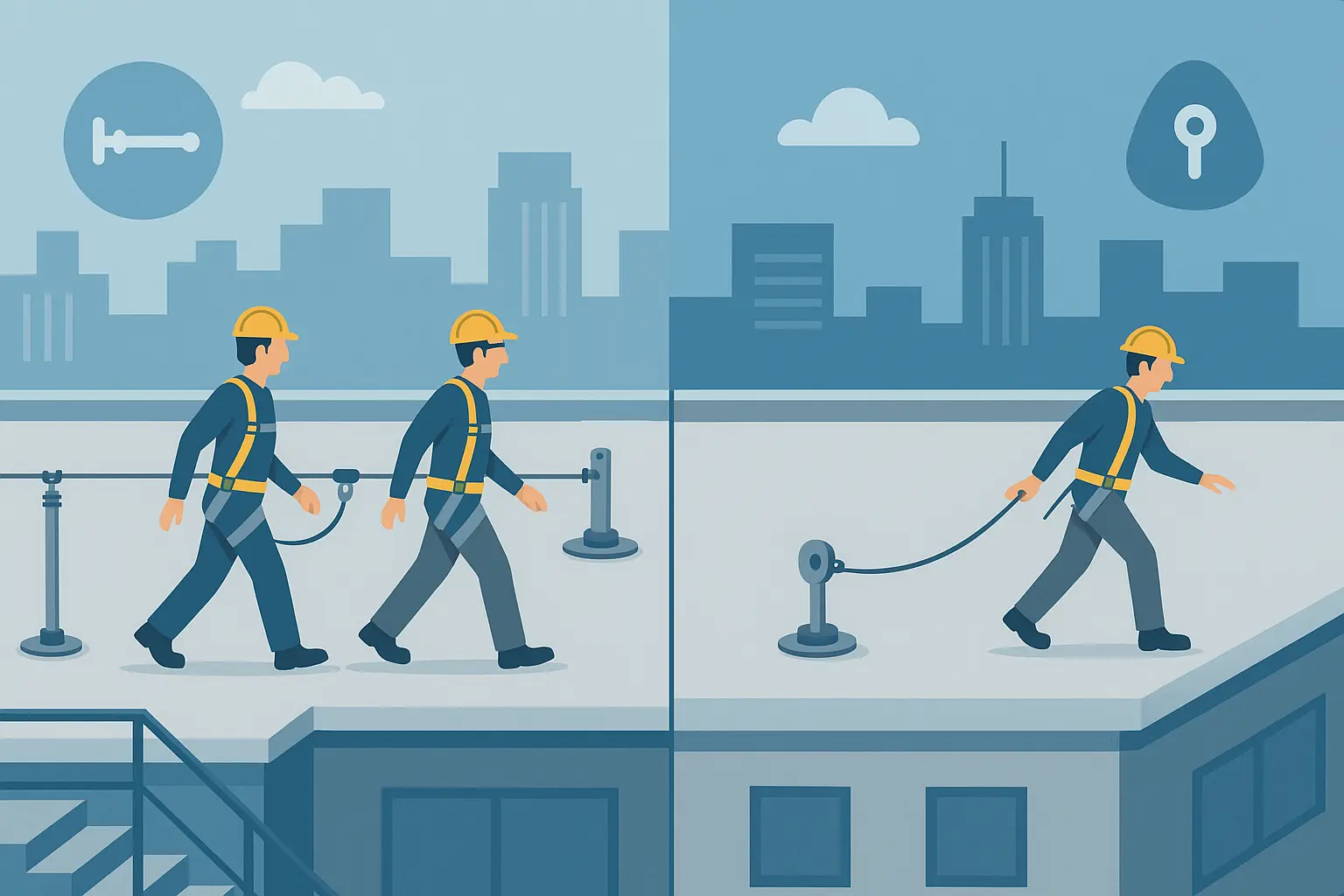
What makes Type A systems particularly relevant for horizontal applications is their simplicity and reliability. Each anchor point operates independently, which means if one fails, it doesn’t compromise the entire system. However, this independence comes with operational constraints—workers must disconnect and reconnect as they move between points, creating potential exposure periods.
Type C: Flexible Horizontal Lifelines
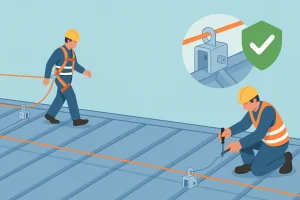
Type C systems employ “a flexible anchor line which deviates from the horizontal by not more than 15 degrees.” These are your cable-based horizontal lifeline systems—what we at Universal Safety Systems have perfected with our Roof Angel system.
The key advantage here is continuous attachment. Workers can move along the entire line without ever disconnecting from the system. Our Roof Angel system, for instance, uses an 8mm stainless steel cable with force absorption technology that minimises structural loading during a fall event.
Technical Requirements: Where the Rubber Meets the Roof
Both classifications must meet stringent testing requirements, but they’re evaluated differently due to their distinct operational characteristics.
Testing Standards Comparison
| Test Type | Class A | Class C | Key Differences |
|---|---|---|---|
| Dynamic Performance | Single point 100kg drop | Distributed load along line | Class C must account for line deflection |
| Static Strength | 12kN for 3 minutes | 12kN distributed across anchors | Class C requires intermediate support calculations |
| Corrosion Resistance | 48 hours salt spray | 48 hours salt spray | Identical requirements |
| Deformation | Maximum allowable set | Line sag and support deflection | Class C has additional sag criteria |
The critical difference lies in how forces are distributed and managed. Class C systems must pass dynamic performance tests where the loading is distributed along the flexible line, whilst Class A systems are tested at individual anchor points.
Force Absorption: The Game Changer
Our Roof Angel system incorporates shock-absorbing polyurethane technology within the posts. During a fall event, this reduces the maximum force transmitted to the structure to less than 10kN—significantly below the 12kN test requirement. This isn’t just about meeting standards; it’s about preserving the structural integrity of the building.
Traditional Class A systems rely on energy-absorbing lanyards to manage fall forces. Whilst effective, this places the full dynamic loading on a single structural point. For older buildings or lightweight roof constructions, this concentrated loading can be problematic.
When to Choose Class A Systems
Class A anchor points excel in specific scenarios:
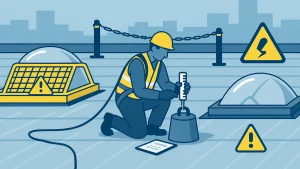
Isolated Work Areas: When work is confined to a small area around a single point—maintenance of a rooftop unit, for instance—a Type A anchor point provides simple, reliable protection without the complexity of a linear system.
Structural Constraints: Some roof designs simply cannot accommodate the distributed loading of a horizontal lifeline. Heritage buildings or structures with limited load-bearing capacity may require the point-specific approach of Class A systems.
Cost-Sensitive Projects: For smaller installations, the per-point cost of Class A anchors is often more economical than installing a comprehensive lifeline system.
Multi-Level Access: When workers need protection at varying heights or on complex geometries, multiple Class A points can provide more flexible coverage than a horizontal system.
However, there’s a significant operational consideration: worker behaviour. Every time someone must disconnect and reconnect to move between anchor points, there’s a moment of vulnerability. We’ve observed that this transition period is where many near-miss incidents occur.
When Class C Systems Are Essential
Horizontal lifelines become indispensable when:
Extended Linear Work: Gutter maintenance, edge detail work, or any task requiring movement along a building’s perimeter demands continuous attachment. Our Roof Angel horizontal lifeline system allows workers to traverse an entire roofline without interruption.
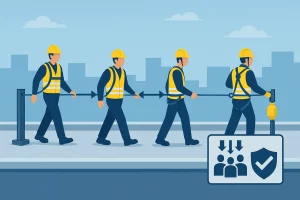
Multiple Worker Scenarios: Whilst EN 795:2012 only covers single-user applications, CEN/TS 16415:2013 addresses multi-user requirements. Properly designed Class C systems can accommodate multiple workers simultaneously—critical for construction teams or major maintenance projects.
Complex Geometries: The Roof Angel system can navigate corners and elevation changes through specially designed brackets, maintaining continuous protection where multiple Class A points would create gaps in coverage.
Psychological Factors: There’s an often-overlooked human element here. Workers report feeling more confident and secure when continuously attached to a lifeline system. This confidence translates to more efficient work and fewer safety shortcuts.
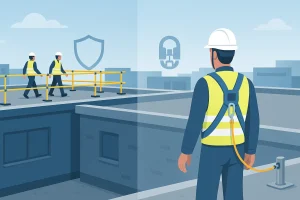
It’s worth noting that whilst horizontal lifelines provide excellent mobility for fall protection, they represent a lower level in the work at height hierarchy compared to collective protection measures like guardrails. When feasible, collective protection should always be the first consideration.
Installation Considerations: The Devil in the Details
The 2012 revision of EN 795 introduced a crucial requirement: devices must be removable from the structure to comply, whereas the 1996 standard allowed anchor devices to be permanently fixed. This affects both classifications but has particular implications for horizontal lifelines.
Structural Assessment Requirements
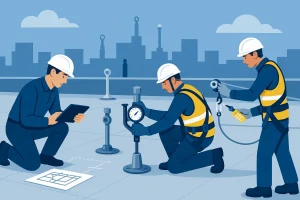
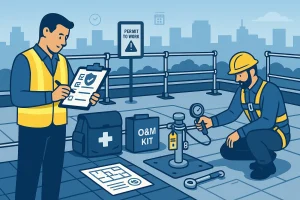
For both systems, you must verify that anchor points can withstand the test forces specified in the standard. However, Class C systems require additional calculations for intermediate supports and end terminations. The Roof Angel system addresses this through our bespoke calculation software that ensures all installations remain within safe working limits.
Substrate Compatibility
The manufacturer must demonstrate that the fall protection systems, PPE, substrate and method of fixing are compatible and provide a safe installation. Universal Safety Systems has conducted extensive testing across various roof types:
- Standing seam metal roofing
- Composite panel systems
- Built-up bituminous roofing
- Single-ply membrane systems
- Concrete and masonry substrates
Each substrate requires specific fixing methods and load distributions. What works perfectly on a concrete roof may fail catastrophically on a lightweight metal deck.
Maintenance and Lifecycle Management
Class A and Class C systems have markedly different maintenance profiles:
Class A Maintenance
- Individual point inspection (typically easier access)
- Component-specific replacement
- Lower inventory requirements
- Simpler record-keeping
Class C Maintenance
- Systematic line inspection (requires more time)
- Cable tension verification
- Intermediate support checks
- More complex documentation
However, our Roof Angel system includes several maintenance advantages. The shock-absorbing posts can be replaced without removing base plates, avoiding costly roof disturbance. The corrosion-free materials—316 stainless steel components and aluminium posts—significantly extend service intervals. For detailed maintenance guidance, see our comprehensive product specifications.
Regulatory Landscape: Navigating the Standards Maze
The current regulatory situation adds complexity to system selection. Types A, C and D are now likely to be harmonised under the Construction Products Regulations rather than the PPE Directive. This means:
- No CE marking requirements for Class A or C systems
- Greater emphasis on manufacturer quality systems
- More detailed documentation requirements
- Independent test certification becomes more critical
For specifiers, this shifts focus from simply checking for CE marks to verifying comprehensive test reports and quality management systems. Universal Safety Systems maintains ISO 9001 quality management and provides full EN 795 test reports from SATRA Technology Centre for all our systems. Our commitment to quality and compliance extends across our entire range of fall protection solutions.
Making the Right Choice: A Practical Framework
Here’s how we recommend approaching the decision:
Step 1: Task Analysis
- Map the work areas and required movement patterns
- Identify frequency and duration of access needs
- Consider the number of simultaneous users
Step 2: Structural Assessment
- Evaluate load-bearing capacity at potential anchor points
- Consider building age and construction type
- Assess maintenance access for the protection system itself
Step 3: Economic Analysis
- Compare installation costs (including structural modifications)
- Factor in operational efficiency gains
- Consider long-term maintenance requirements
Step 4: Risk Assessment
- Evaluate the consequences of disconnection periods with Class A systems
- Consider worker competency levels
- Assess environmental factors (wind exposure, weather conditions)
The Future of Horizontal Fall Protection
As building designs become more complex and maintenance requirements more stringent, we’re seeing increased adoption of Class C systems. The continuous attachment capability simply offers superior protection for most rooftop applications.
However, technological developments are also improving Class A systems. Self-retracting lifelines with leading-edge capability are making single-point systems more versatile, whilst advances in temporary horizontal systems are blurring the traditional boundaries between classifications.
Our Recommendation: Context Is King
There’s no universal answer to the Class A versus Class C question. However, for most commercial and industrial roof applications involving linear work patterns, Class C systems offer superior safety outcomes. The Roof Angel horizontal lifeline system exemplifies this approach—providing continuous protection whilst minimising structural impact through innovative force absorption technology.
The key is matching the system to the specific application requirements. Class A systems remain excellent solutions for isolated work areas or structurally constrained installations. Class C systems excel where worker mobility and continuous protection are paramount.
Ultimately, the best fall protection system is the one that gets used correctly, consistently, and confidently by the workers who depend on it. Whether that’s a simple eyebolt or a sophisticated horizontal lifeline system depends entirely on understanding the unique requirements of each project.
Universal Safety Systems has been designing and installing fall protection systems for over two decades. Our Roof Angel horizontal lifeline system meets both EN 795:2012 Type C requirements and CEN/TS 16415:2013 multi-user specifications. For project-specific guidance or technical support, contact our team of fall protection specialists.
Related Reading
- Guardrails vs Lifelines: Applying the Work at Height Hierarchy in Practice – Understanding when to choose collective protection over personal fall protection systems
- BS 13700 Explained: The Standard for Permanent Counterweighted Guardrails – Comprehensive guide to guardrail standards and applications
- Single Point Anchorages & Abseil Points – Product specifications for Class A anchor systems
- Guardrail Systems – Explore our GuardAngel collective protection solutions