Introduction
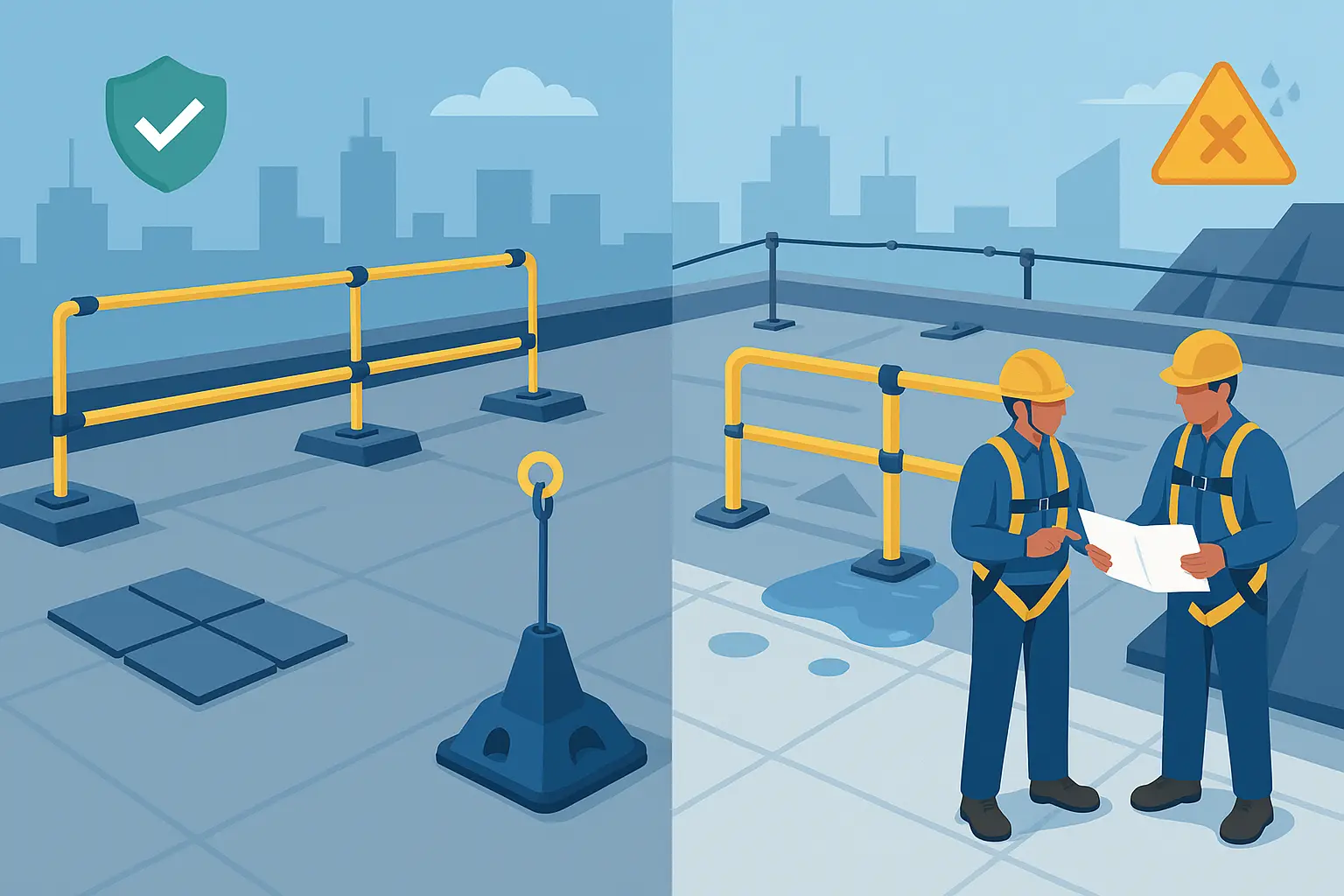
Choosing the right fall protection system isn’t just about meeting regulations—it’s about finding the sweet spot between safety performance, installation practicality, and long-term building integrity. After decades of installing both penetrative and non-penetrative systems across countless rooftops, we’ve learned that the “best” solution often depends on factors many safety professionals don’t initially consider.
The Non-Penetrative Advantage
When building owners first hear about non-penetrative systems, their immediate reaction typically focuses on avoiding roof penetrations. While that’s certainly a benefit, it only scratches the surface of what makes these systems valuable.
Consider the WeightAngel system we regularly install. Yes, it eliminates the need to drill through membranes, but the real advantage becomes apparent during maintenance cycles. We’ve worked with facilities teams who can relocate entire anchor points without involving roofing contractors or risking warranty voidance. That flexibility proves invaluable when building use patterns change or equipment layouts shift.
When Non-Penetrative Systems Excel
| Scenario | Why Non-Penetrative Works | USS Solution |
|---|---|---|
| Single-ply membrane roofs | Preserves membrane integrity, maintains warranties | WeightAngel with membrane-friendly base design |
| Temporary access requirements | Quick deployment, easy reconfiguration | GuardAngel modular system |
| Historic buildings | No structural alterations required | Custom weighted solutions |
| Rental/lease properties | Removable without structural damage | Portable GuardAngel configurations |
The structural loading considerations often surprise safety managers. Unlike penetrative systems that create point loads at attachment points, weighted systems distribute forces across larger roof areas. We’ve installed systems on structures where traditional anchors would have required costly reinforcement work.
WeightAngel Non-Penetrative Anchor Solutions
For specifications, testing and installation guidance on the WeightAngel Non-Penetrative Anchor Solutions from Universal Safety Systems, click the link.
When Non-Penetrative Falls Short
Honesty matters in fall protection. While we’re passionate advocates for non-penetrative systems, we’re also realistic about their limitations. Some situations simply demand traditional approaches.
Wind loading presents the most significant challenge. We’ve learned this through both engineering calculations and real-world experience. High-rise buildings with exposure categories C or D often generate wind loads that require impractical amounts of ballast weight. There’s a tipping point where a weighted system becomes so heavy that it creates more structural concerns than the penetrations it’s meant to avoid.
Weight vs. Wind: The Critical Balance
The physics are straightforward, but the practical implications catch many specifiers off guard. Our GuardAngel system, for instance, performs brilliantly in most applications. However, once you hit certain height and exposure combinations, the ballast requirements become prohibitive.
We recently evaluated a pharmaceutical facility where initial enthusiasm for non-penetrative solutions gave way to hybrid approaches. The lower roof areas used our weighted systems perfectly, while the elevated equipment platforms required traditional anchors. Rather than forcing a one-size-fits-all solution, we designed complementary systems that shared common components and training requirements.
RoofAngel Horizontal Lifeline System
For specifications, testing and installation guidance on the RoofAngel Horizontal Lifeline from Universal Safety Systems, click the link.
The Engineering Reality Behind Weight Calculations
Safety professionals often underestimate the complexity of ballast calculations. It’s not simply a matter of adding enough weight to resist expected loads. Modern building codes require consideration of dynamic factors, partial loading scenarios, and serviceability limits that go well beyond basic overturning calculations.
Wind uplift creates particular challenges on membrane roofs. The suction forces that develop during storm events can significantly reduce the effective weight of ballasted systems. We’ve seen installations where inadequate analysis led to systems that met static requirements but failed under dynamic conditions.
Beyond Basic Load Calculations
The devil lives in the details with weighted systems. Roof deflection under load, long-term creep considerations, and thermal cycling effects all influence performance. These factors rarely appear in simplified vendor calculations but become critical for long-term reliability.
Our approach involves detailed structural analysis for every significant installation. This upfront investment prevents costly surprises and ensures systems perform as intended throughout their service life.
Installation Realities
Installation practicality often determines system selection more than theoretical performance. Non-penetrative systems promise simplified installation, but that advantage depends heavily on site conditions and access constraints.
Getting ballast weights onto rooftops presents logistical challenges that don’t exist with penetrative systems. We’ve developed specialized lifting and positioning techniques, but building owners need to understand the access requirements during initial planning phases.
| Installation Factor | Non-Penetrative Considerations | USS Approach |
|---|---|---|
| Material handling | Heavy ballast weights require crane access | Modular weights, staged installation |
| Weather sensitivity | Positioning accuracy critical for stability | All-weather installation procedures |
| Quality control | Visual inspection vs. torque verification | Systematic positioning and load verification |
Maintenance and Lifecycle Considerations
The maintenance story reveals another dimension where non-penetrative systems shine—with important caveats. WeightAngel installations require periodic inspection of weight positioning and base conditions, but these checks involve straightforward visual assessment rather than specialized equipment.
However, the modular nature that makes these systems flexible also creates maintenance responsibilities. Components can shift, weights can settle, and connections require periodic verification. Traditional anchors, once properly installed, demand less ongoing attention.
We recommend structured inspection programs that account for these differences. The accessibility advantages of non-penetrative systems make routine maintenance easier to perform but more critical to schedule.
Cost Analysis
Cost comparisons between penetrative and non-penetrative systems require careful analysis of total lifecycle expenses. While weighted systems often carry higher initial material costs, they can deliver savings in other areas.
Installation labor typically balances out—non-penetrative systems eliminate drilling and sealing work but require more careful positioning and heavier material handling. The real cost differences emerge during building lifecycle events like roof replacement, system modifications, or facility reconfigurations.
Total Cost of Ownership Factors
- Roof warranty preservation with non-penetrative systems
- Flexibility for future modifications without re-engineering
- Potential rental/resale value for removable systems
- Reduced structural modification costs
- Different insurance implications for building integrity
Making the Right Choice
After years of system installations across diverse applications, we’ve developed a practical framework for system selection. Rather than defaulting to either approach, we evaluate multiple factors that determine optimal solutions.
Building height and exposure create the primary screening criteria. Structures below four stories with reasonable wind exposure often work well with non-penetrative approaches. Beyond that threshold, detailed analysis becomes essential.
Roof membrane type influences the equation significantly. Single-ply systems with extended warranties favor non-penetrative approaches, while built-up roofs with established track records for penetration sealing may tip toward traditional anchors.
Key Decision Factors
- Wind exposure and building height – Primary technical screening
- Roof construction and warranty requirements – Business risk considerations
- Structural capacity and loading distribution – Engineering constraints
- Access logistics and installation windows – Practical execution factors
- Future flexibility requirements – Lifecycle planning
The Hybrid Approach
Our most successful projects often combine both approaches strategically. Non-penetrative systems handle perimeter protection and temporary access needs, while critical anchor points use traditional installations. This hybrid strategy optimizes performance while managing costs and complexity.
The GuardAngel system’s modular design facilitates these mixed approaches. Common connection details and compatible components allow seamless integration between weighted and anchored sections.
RoofAngel & WeightAngel
For specifications, testing and installation guidance on the RoofAngel Horizontal Lifeline or our WeightAngel Anchor System, click the links.
Future Considerations and Industry Evolution
Non-penetrative technology continues advancing rapidly. Improved ballast designs, better weight distribution systems, and enhanced connection methods are expanding the viable application range.
However, fundamental physics won’t change. Wind loads, structural limitations, and weight penalties will always create boundaries for weighted systems. The key lies in understanding these boundaries and designing solutions that work within them.
Next Steps
Selecting fall protection systems requires balancing multiple competing factors. Non-penetrative solutions offer compelling advantages in many situations, but they’re not universal answers.
We recommend starting with a comprehensive site evaluation that considers technical requirements alongside practical constraints. Our experienced team can help you navigate these decisions and develop solutions that protect your workers while meeting your broader facility objectives.
Whether you’re planning new installations or evaluating existing systems, the choice between penetrative and non-penetrative approaches deserves careful analysis. The right decision depends on your specific situation—not industry generalities or vendor preferences.
Contact our team to discuss your specific fall protection challenges and explore how our GuardAngel guardrail systems and WeightAngel anchor solutions might serve your needs. Every project presents unique opportunities to optimize safety, cost, and performance.